
Property Tax Amendment 3 – What it means for Okaloosa County

New Homestead Exemption
Creates a new statewide homestead exemption of $150,000 in 2027 and $250,000 in 2028, applicable to all levies excluding school districts.
Non-homestead Assessment Cap
Reduces the assessment cap on non-homestead properties (e.g. second homes and commercial real estate) from 10% to 5%.
Residency Requirement
Requires a five-year Florida residency period before new residents qualify for the expanded exemption.
Automatic Inflation Growth
Grows both exemptions automatically with inflation each year.
Millage Rate Ceiling Narrowed
Narrows the default maximum millage rate to the roll-back millage rate. A rate of not more than 110 percent of the rolled-back rate may be adopted if approved by a two-thirds vote of the membership of the governing body. A rate in excess of 110 percent may be adopted if approved by a unanimous vote of the membership of the governing body.
Constitutional Category Lock
Restricts county and municipal ad valorem to a closed list of seven categories:
a. Provide for public safety, including law enforcement, fire service, and emergency medical service;
b. Provide funding for education and public schools;
c. Finance or refinance infrastructure, including expenditures on road and bridge construction and maintenance and stormwater control;
d. Finance or refinance natural resource projects, including flood control measures;
e. Issue local bonds and to make debt service payments for existing obligations;
f. Meet obligations for retirement benefits of local government employees;
g. Fund the operations and administration of county officers and commissioners established under Article VIII and municipalities, and the expenditures approved by such county officers or county or municipal governing bodies, except those expenditures prohibited by general law.
Estimated Impact
Based on Okaloosa County’s current taxable values for homesteaded properties and millage rates in place for the Fiscal Year 2026, the following provides an estimate of the financial impact of exempt homestead property tax collection.
| Okaloosa County BCC & Unincorporated MSTU | Countywide (Includes County, municipalities, fire districts, etc.) | |
| Year 1: $150,000 Homestead Exemption would create an estimated reduction of | $15,406,266 | $26,743,256 |
| Year 2: $250,000 Homestead Exemption would create an estimated reduction of | $24,970,995 | $43,111,108 |
For detailed information regarding the impact to the County’s nine municipalities, click here.
________________________________________________________________________________________________________________
DOLLAR BREAKDOWN
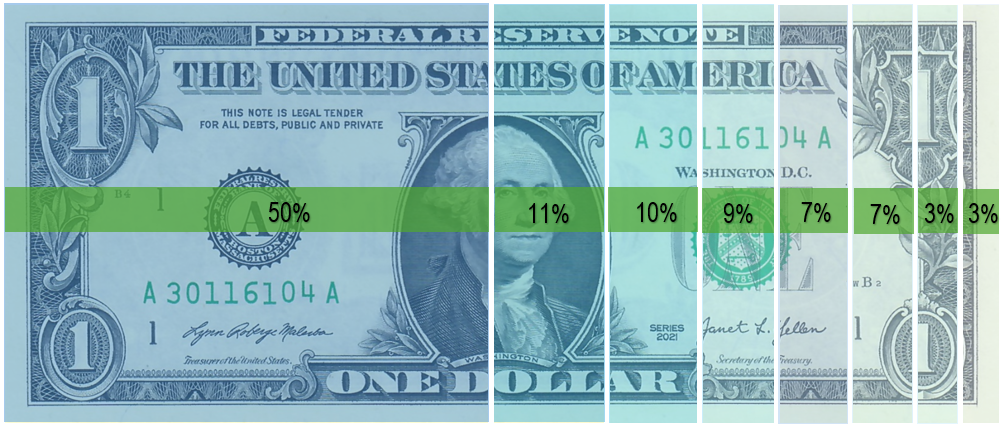
Reductions in property tax collections affect the amount of funds that can be invested into county services. The following shows the county's current allocation of property tax revenues (FY 27 Budget) for each category.
|
Percentage |
Dollar Amount |
Funding Type |
Details |
|
50% |
$59,370,614 |
Public Safety |
Law Enforcement & Corrections: Law enforcement, crime prevention and investigation, patrol services, detention and inmate services, and correctional facility operations.
Fire & Emergency Services: Fire protection, emergency preparedness, disaster response, emergency coordination, and public warning services.
Protective & Public Safety Services: Public safety, visitor assistance, and enforcement support within County parks and beach facilities. |
|
11% |
$12,488,567 |
Countywide Administration & Services |
County Leadership & Administration: Board of County Commissioners, County Administrator, and Clerk to the Board.
Legal & Government Services: County legal services and other governmental support functions.
Economic & Community Development: Industry development, economic development initiatives, and community redevelopment activities.
Interfund Transfers: Transfers of resources between County funds to support designated programs, services and additional court costs. |
|
10% |
$12,072,117 |
Internal Operations |
Administrative Services:
Human Resources & Technology:
Financial Management:
|
|
9% |
$10,467,120 |
Reserves |
Reserves & Contingency:
|
|
7% |
$8,682,213 |
Constitutional Offices |
Constitutional & Judicial Services: Property valuation and assessment, collection of property taxes, election administration, child protection services, legal representation for indigent defendants, court operations, and pretrial supervision and services.
|
|
7% |
$7,965,864 |
Community Planning & Quality of Life Services |
Planning, Environmental & Development Services: Land use planning, development review, code compliance, affordable housing services, and environmental conservation.
Quality of Life and Community Services: Agricultural education and assistance, veteran support services, assistance to individuals and families in need, community recreation and parks, and public library services.
Health Services: Disease prevention and public health services, mental health services, mosquito control, medical examiner services, and community health services. |
|
3% |
$3,916,955 |
Capital Projects |
Capital Improvements:
|
|
3% |
$3,735,861 |
Transportation |
Transit & Transportation Services: Public transportation services, transit operations, and transportation-related funding for capital and infrastructure needs.
|
A proposed amendment to the Florida Constitution, CS/HJR 1-F, will be presented to Florida voters in November 2026. If approved by at least 60 percent of voters, the amendment would increase the homestead exemption for qualifying properties, reduce the annual assessment increase limitation for certain non-homestead properties, and establish limitations on the use of certain ad valorem tax revenues by counties and municipalities.
A homestead property is generally a homeowner's primary residence that qualifies for Florida's homestead exemption. Vacation homes, rental properties, and investment properties generally do not qualify for the homestead exemption.
For qualifying homeowners who maintained permanent Florida residency as of December 31, 2026, the amendment would increase the exemption applicable to non-school property taxes to up to $150,000 beginning January 1, 2027, and up to $250,000 beginning January 1, 2028. The $250,000 amount would be adjusted annually for positive inflation beginning in 2029.
No. The proposed amendment establishes different provisions for individuals who establish Florida residency and homestead after January 1, 2027. Those homeowners would initially receive an exemption of up to $50,000 for non-school property taxes, with provisions allowing them to qualify for the larger exemption after five years of Florida residency.
Yes. The proposed amendment would reduce the current limitation on annual increases in assessed value for certain non-homestead residential and non-residential property from 10 percent to 5 percent.
An increase in the homestead exemption would reduce the amount of taxable value subject to County property taxes. The resulting reduction in property tax revenue would reduce the amount of funding available to the County for services, operations, reserves, and capital needs.
Property tax revenue supports a range of County functions, including public safety, parks, libraries, internal operations and general government, constitutional offices, reserves, and capital projects.
The graphic represents how County property tax revenue is allocated among major functions and is not a breakdown of every dollar in the County's overall budget. The percentages are based on the County's property-tax-supported expenditures included in the analysis.
A reduction in property tax revenue would reduce the amount of recurring revenue available to fund services. The specific effect on services, staffing, programs, capital projects, or other expenditures would depend on future budget decisions made by the Board of County Commissioners.
Public Safety represents the largest category of property-tax-supported expenditures primarily due to the costs associated with law enforcement and corrections. The Sheriff's Office and Corrections Department account for approximately $54.4 million of the $55.3 million in property-tax-supported Public Safety expenditures, with the remaining amount supporting emergency management, emergency communications, fire control, and other public safety functions.
The County has multiple sources of revenue in addition to property taxes. However, the availability and amount of alternative revenue sources vary by source and may be subject to statutory restrictions, existing commitments, and other limitations. Any future changes to revenues or expenditures would be determined through the County's budget process.
The proposed constitutional amendment does not establish a recurring State funding source specifically intended to replace property tax revenue lost by counties as a result of the increased homestead exemption. The impact on individual counties would depend on the amount of taxable value affected and the applicable local tax rates.
Yes. The proposed amendment would increase the homestead exemption applicable to non-school property taxes, but it would not eliminate a homeowner's entire property tax bill. School district taxes and other applicable taxes, assessments, or charges may continue to apply.
Potentially. The amendment directly changes the taxation of qualifying homestead property, but changes in the amount of property tax revenue available to local governments could affect future budget decisions involving services, infrastructure, and other expenditures. The amendment would also change the assessment limitation applicable to certain non-homestead properties.
Okaloosa County’s financial condition is generally stable with several favorable trends, especially in net position growth and debt management.
Per County policy, the General Fund maintains a total minimum reserve level of no less than two months (17%) of operating expenditures, consistent with the Government Finance Officers Association (GFOA) recommendation. In order to maintain service levels, the County could potentially utilize reserves to continue services; however, this solution would be temporary as reserves are limited. Further, the County could be left vulnerable to natural disasters or economic downturns necessitating the availability of a healthy reserve.
Okaloosa County holds a “AAA” (triple-A) issuer default rating and general obligation bond rating from Fitch, and an “AA” issuer credit rating from S&P Global Ratings. These ratings are indicative of the County’s capacity to repay debt which is supported by strong financial management, economic resilience, and low long-term liabilities. As property taxes represent the largest share of general fund revenue, approval of the constitutional amendment could impact the County’s debt rating leading to higher borrowing costs, restrict access to capital and impair the County’s ability to pay off bond debt.
Okaloosa County neither supports nor opposes the proposed amendment. The purpose of this webpage is to provide factual information about the proposed amendment and its potential fiscal implications for Okaloosa County. The information is intended to help residents understand the proposal and its potential effects and is not intended to advocate for or against the amendment.
To learn more about property taxes, visit the Okaloosa County Property Appraiser’s website or click here to review a Frequently Asked Questions document.